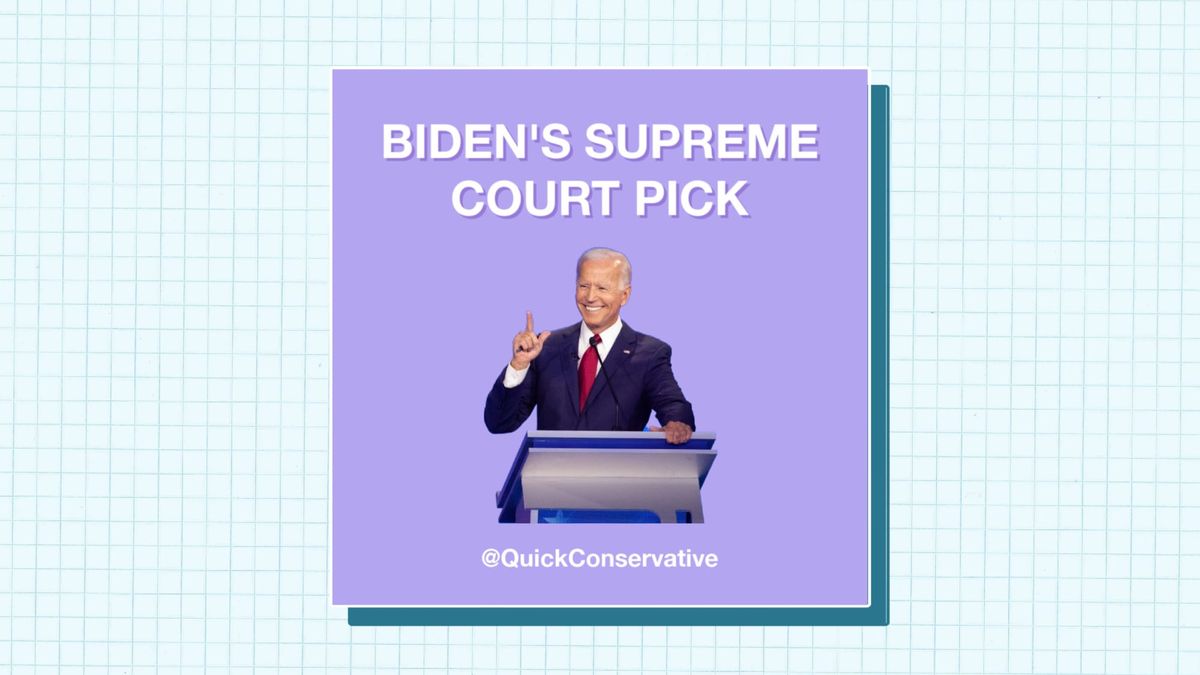
Biden's Supreme Court Pick


As described by the White House in a May 5, 2021 fact sheet, the Restaurant Revitalization Fund - established through the American Rescue plan - "will prioritize funding applications from small businesses owned and controlled by women, veterans, and socially and economically disadvantaged individuals for the first 21 days of the program. Following the 21 days, all eligible applications will be funded on a first-come, first-served basis."
The relief bill defines "social and economic disadvantage" by reference to the Small Business Act, which says a person is considered "socially disadvantaged" if he has been "subjected to racial or ethnic prejudice" or "cultural bias" based solely on his immutable characteristics. A person is considered "economically disadvantaged" if 1) he is socially disadvantaged, and 2) he faces comparative "diminished capital and credit opportunities."
The Small Business Administration has injected explicit racial and ethnic preferences into the priority process. (See 13 C.F.R. § 124.103.) Under a regulation that predates the pandemic, the agency presumes certain applicants are socially disadvantaged based solely on their race or ethnicity. Groups that presumptively qualify as socially disadvantaged include Americans who are “Black, Hispanic, Asian Pacific, Native Americans, and Subcontinent Asian Americans.” If you are in one of these groups, the Small Business Administration assumes you qualify as socially disadvantaged. As the plaintiffs summarize, "Indeed, the only way not to qualify is if someone comes forward with credible evidence to the contrary."
Antonio Vitolo of Jake's Bar and Grill sought an emergency injunction to stop the government from using what he claimed were "unconstitutional criteria" in processing his relief application. Vitolo was white and his wife Hispanic; they each owned 50% of the restaurant. Since the restaurant was not 51% owned by a woman, veteran, or "socially disadvantaged" individual, they did not qualify for priority processing (which was important because, as the plaintiffs point out: "The key to getting a grant is to get in the queue before the money runs out").
On May 27, 2021, the United States Court of Appeals for the Sixth Circuit reminded federal defendants: "Government policies that classify race are presumptively invalid," noting that while City of Richmond v. J.A. Cronson Co. (1989) tells us that remedial policies can sometimes justify preferential treatment based on race, "the bar is a high one." The policy must 1) target a specific episode of past discrimination, 2) there must be evidence of intentional discrimination in the past, and 3) the government must have had a hand in the past discrimination it now seeks to remedy. In the present restaurant case, the Court ruled, "the government's asserted compelling interest meets none of these requirements."
The Court went on to note that even if the government had shown a compelling interest, their restaurant policy was not "narrowly tailored."
"Like racial classifications, sex-based discrimination is presumptively invalid," the Court wrote, noting government policies that discriminate based on sex cannot stand unless the government provides an “exceedingly persuasive" justification. To meet this burden, the government must prove that 1) a sex-based classification serves "important governmental objectives," and 2) the classification is "substantially and directly related" to the government's objectives. According to the Court, the government's restaurant case "fails to satisfy either prong."
Other key quotes from the Court's decision: "The dispositive presumption enjoyed by designated minorities bears strikingly little relation to the asserted problem the government is trying to fix," "The stark realities of the Small Business Association's racial gerrymandering are inescapable," "Their is no need to use sex as a proxy when the government seeks to remedy a problem that is purely economic," and "as today's case shows once again, the way to stop discrimination on the basis of race is to stop discriminating on the basis of race (Parents Involved, 551 U.S. at 748)."
For further reading, see: United States Court of Appeals for the Sixth Circuit, May 27, 2021.
The American Rescue Plan Act was enacted on March 11, 2021. Under Section 1005, the Act states that Congress may allow loan forgiveness (appropriating "such sums as may be necessary" for "loan modifications and payments") to "socially disadvantaged" farmers and ranchers.
Twelve white plaintiffs, who reside in nine different states, brought action against the Secretary of Agriculture and Administrator of the Farm Service Agency to stop the USDA from implementing the program, which they claimed "denies equal protection of the law" based "solely on racial classifications."
The government had defined “socially disadvantaged farmer or rancher” to include individuals “who are one or more of the following: Black/African American, American Indian, Alaskan native, Hispanic/Latino, Asian, or Pacific Islander.”
The Court ruled to grant a temporary restraining order (to preserve the status quo pending the complete briefing and consideration of a motion for a preliminary injunction), noting the government "lacks a compelling interest for the racial classifications."
Other key quotes from the Court: "Aside from a summary of statistical disparities,[the involved government agencies] have no evidence of intentional discrimination by the USDA in the implementation of the recent agriculture subsidies and pandemic relief efforts," "Defendants have failed to establish that it has a compelling interest... [or] that the remedy is narrowly tailored," "[Congress] cannot discriminate on the basis of race," "Plaintiffs are excluded from the program based on their race and are thus experiencing discrimination at the hands of their government," and "The obvious response to a government agency that claims it continues to discriminate against farmers because of their race or national origin is to direct it to stop: it is not to direct it to intentionally discriminate against others on the basis of their race and national origin."
For further reading, see: United States District Court Eastern District of Wisconsin, June 10, 2021.
On August 3, 2021, a day after a Senior White House Advisor said the administration's been unable to find legal authority for even "targeted eviction moratoriums," President Biden answered a related question, stating: "The bulk of the constitutional scholarship says that it’s not likely to pass constitutional muster. Number one. But there are several key scholars who think that it may and it’s worth the effort. [...] I have been informed [the CDC is] about to make a judgment as to potential other options. Whether that option will pass constitutional measure with this administration, I can’t tell you. I don’t know. There are a few scholars who say it will and others who say it’s not likely to. But, at a minimum, by the time it gets litigated, it will probably give some additional time while we’re getting that $45 billion out to people who are, in fact, behind in the rent and don’t have the money."
On August 3, 2021, after President Biden's remarks, the CDC introduced a new eviction moratorium, covering "communities with substantial or high levels of community transmission of COVID-19." The order states it will remain in effect until October 3, 2021.
On August 26, 2021, the U.S. Supreme Court put a halt to the CDC's eviction moratorium in Alabama Association of Realtors v. Department of Health and Human Services.
On September 9, 2021, President Joe Biden instructed the Department of Labor to require that all businesses with 100 or more workers are either vaccinated or tested once a week.
On January 13, 2022, the U.S. Supreme Court blocked Biden's mandate in the National Federation of Independent Business v. The Department of Labor, Occupational Safety and Health Administration.
On January 27, 2022, Justice Stephen Breyer announced his plans to retire from the U.S. Supreme Court.
The White House. (5 May 2021). FACT SHEET: The Biden-Harris Administration Supports Hard-hit Restaurants and Bars. Briefing Room.
Antonio Vitolo; Jake’s Bar and Grill, LLC v. Isabella Casillas Guzman, Administrator of the Small Business Administration. (27 May 2021). United States Court of Appeals for the Sixth Circuit. File Name: 21a0120p.06.
Adam P. Faust, et al. v. Thomas J. Vilsack, et al. United States District Court Eastern District of Wisconsin. (10 June 2021). Case No. 21-C-548.
USDA Pandemic Assistance for Producers. Farmers.gov.
Biden, J. (3 August 2021). Remarks by President Biden on Fighting the COVID-19 Pandemic. The White House Briefing Room.
CDC. (3 August 2021). Temporary Halt in Residential Evictions in Communities with Substantial or High Levels of Community Transmission of COVID-19 to Prevent the Further Spread of COVID-19.
Weiss, D.A. (9 Nov. 2020). Biden will be first president since Taft to have a law degree outside T-14; his law prof saw ‘presence’. ABA Journal.
Biden, J. (9 September 2021). Remarks by President Biden on Fighting the COVID-19 Pandemic. The White House Briefing Room.
National Federation of Independent Business v. The Department of Labor, Occupational Safety and Health Administration. (13 January 2022). United States Supreme Court.
Breuninger, K. & Kimball, S. (13 January 2022). Supreme Court blocks Biden Covid vaccine mandate for businesses, allows health-care worker rule. CNBC.
Alabama Association of Realtors v. Department of Health and Human Services. (26 August 2021). United States Supreme Court.