Money for Wars, But Can't Feed the Poor
Are Tupac and Mamdani right?



🗂️ Background: In an NBC interview on April 15, 2026 – quoting Tupac Shakur's 1983 hit, "Keep Ya Head Up" – New York City Mayor Zohran Mamdani criticized military action in Iran, claiming that billions were being spent on military action in the Middle East "at the same time as we're being told that this money cannot be found to invest in working class Americans. I wish that the words of Tupac from the '90s weren’t still prescient, but they continue to be true for too many, which is that 'we always have money for war and not to feed the poor.'"
How much does the U.S. spend on social programs (i.e., "feeding the poor")?
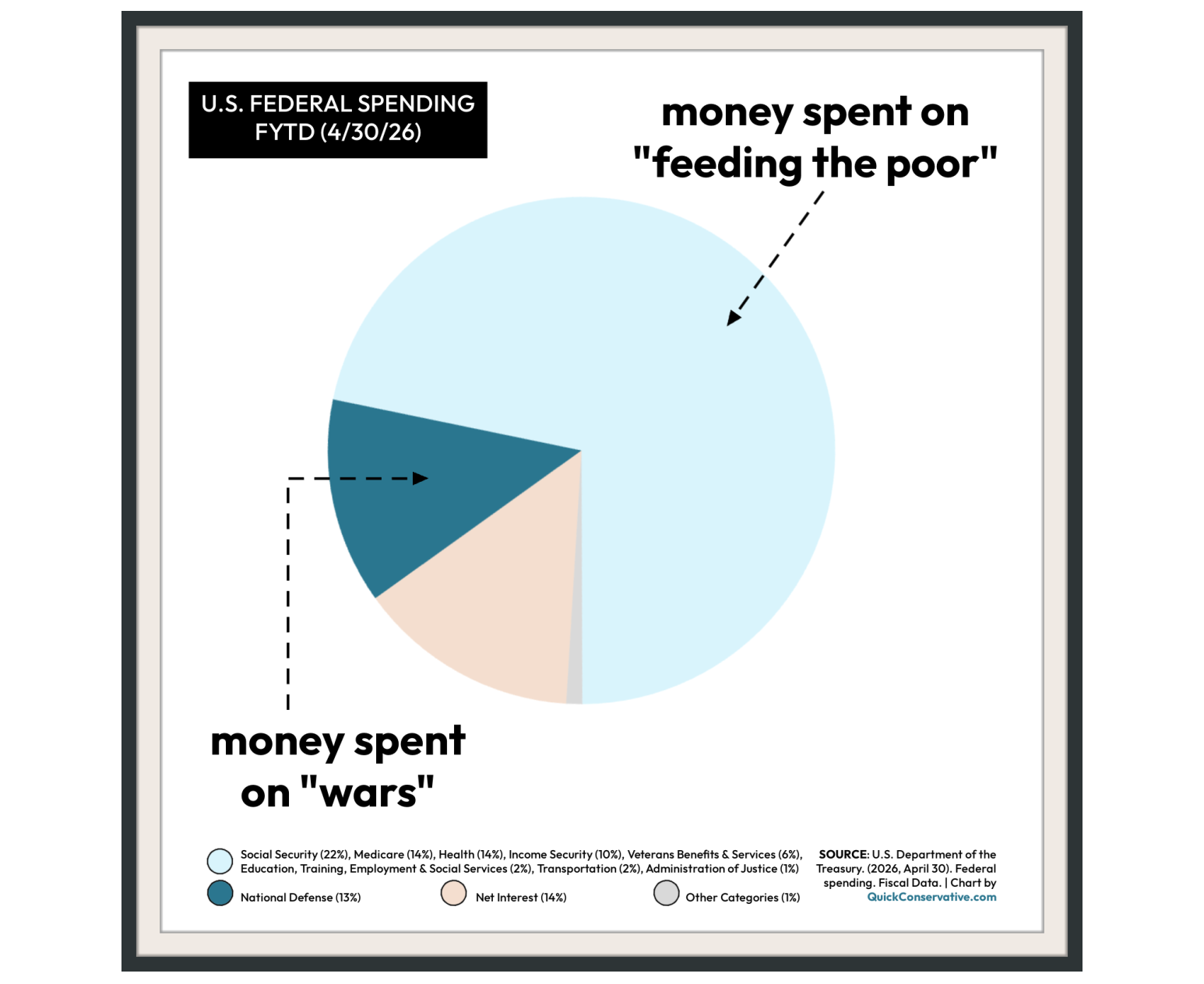
The federal budget is divided into roughly 20 categories (or "budget functions"). According to the Department of Treasury, as of April 30, government spending in 2026 overwhelmingly focused on social categories. Of the $4.27 trillion paid so far, the U.S. government spent over 70% on its citizens, including:
An additional 14% was spent on net interest; one percent was spent on other categories.
[Reading this post in the future? The Treasury Department updates its dashboard in real time; the 2026 Fiscal Year to Date (FYTD) data referenced above is archived here.]
How much does the U.S. spend on national defense (i.e., "wars")?
According to the same 2026 FYTD data, the United States spent a much smaller fraction of its budget on wars:
The following chart illustrates comparative spending:
Importantly, the same trend has held true for decades. To review annual spending by budget category yourself, use the government's Spending Explorer.
NOTE (1): "Transportation" (2%) and "Administration of Justice" (1%) are folded into "feeding the poor", as they directly impact the lives of the "working class Americans" referenced by the initial claim.
NOTE (2): The values above represent outlays (i.e., money actually paid); the Spending Explorer displays obligations (money promised to be paid) – which is why those totals are higher (figures will also vary based on date viewed). However, the same trend remains.
How has spending changed over the years?
An analysis of federal budget historical tables by the CATO Institute found that national defense spending – as a percentage of gross domestic product (GDP) – has primarily decreased or held steady as non-defense spending has increased over time:
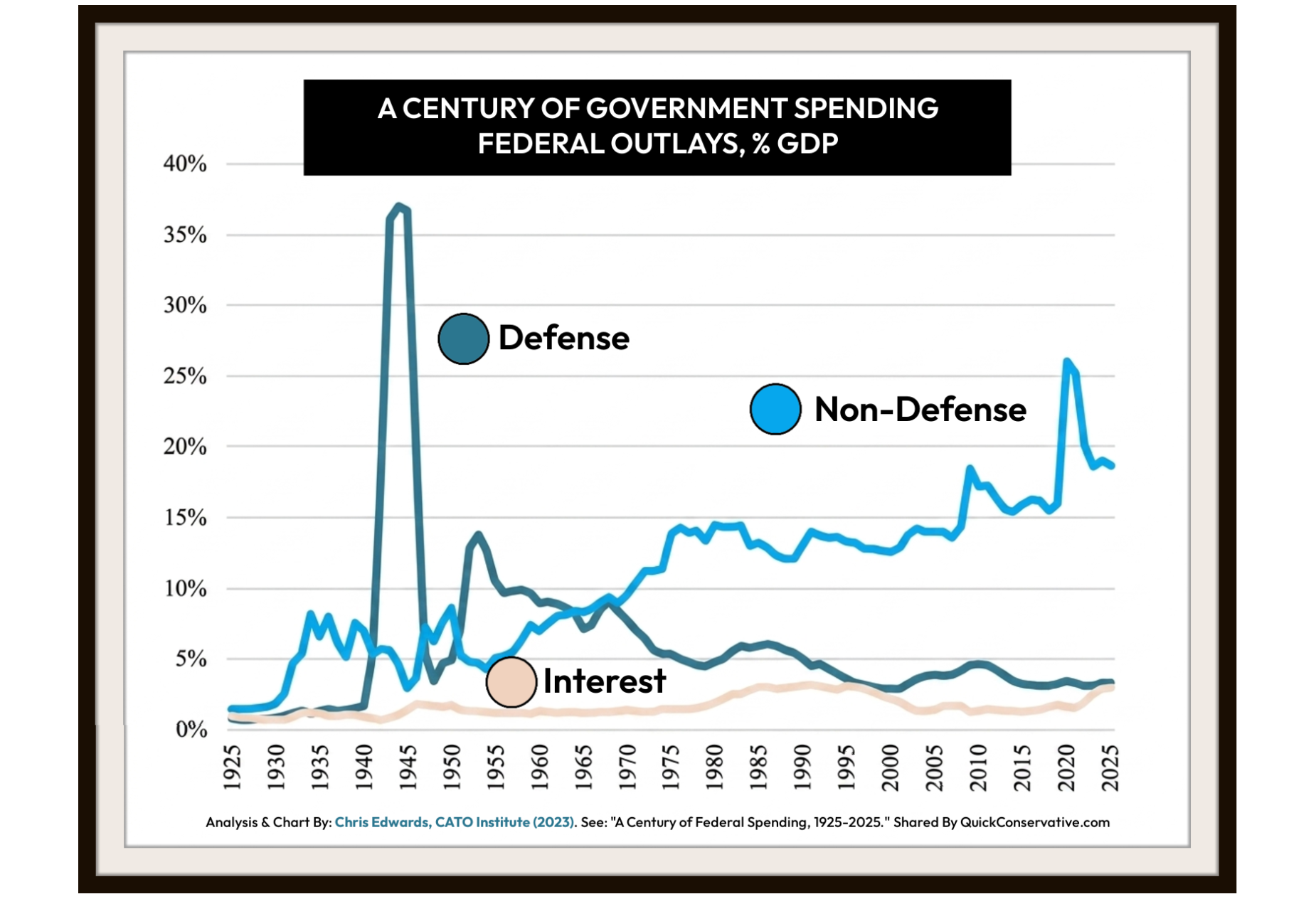
NOTE: For spike/drop explanations, please see CATO's original analysis here.
✏️ The Left Has a Point: The federal budget is divided into mandatory and discretionary spending. Mandatory spending – which is dictated by prior law (and doesn't require an annual vote by Congress) – represents nearly two-thirds of total spending. According to the Congressional Budget Office (CBO), mandatory spending is almost entirely devoted to the social programs listed above (e.g., Social Security, Medicare, Medicaid, Income Security Benefits...). For a full breakdown, please see CBO: FY 2025.
The other third of the budget is reserved for discretionary spending (i.e., money approved by Congress and the President during the appropriations process). According to the Department of Treasury, Congress generally allocates over half of its discretionary budget each year to national defense (and the rest to various agencies and programs). While still resulting in only the small fraction of the overall budget outlined above, this annual allocation is fertile ground for discussion.
Editor's Note: Economist Matt Hill first highlighted today's claim via The Econ Nerds (video available here) and graciously advised re: sources. Thank you, Mr. Hill!
If you thought the U.S. would prioritize war over helping the poor, it's likely because you don't trust your fellow citizens to do the right thing.
In a 2025 survey of 25 countries, the Pew Research Center asked people to rate the morality and ethics of others in their country. The United States is the only surveyed nation where more adults rated fellow citizens as bad (53%) than as good (47%). Of note, given Mayor Mamdani's standing as a Democratic Socialist: Democrats and independents who lean toward the Democratic Party were much more likely than Republicans to rate fellow Americans as morally bad (60% vs. 46%) – which is perhaps why, to Mamdani, Tupac's words rang true.
☎️ Earlier this year, Matter Neuroscience, Inc. ran a six-week project called "Party Line" where two phone booths were connected and then set up in the most liberal and conservative cities in the country: San Francisco, CA and Abilene, TX, respectively. The hook? The California one included a sign saying, "Call a Republican"; the Texas one, "Call a Democrat".
🌎 Project leaders report that "nearly every call was positive" (with only 5% ranking negative), specifically citing overheard phrases including: "We all want the same thing" and "It's us against the world, man".
🎥 You can watch the initial set-up process here :-)
✝️ Jesus said to him, "I am the way, the truth, and the life. No one comes to the Father except through Me." – John 14:6
Congressional Budget Office. (2026, February 11). The budget and economic outlook: 2026 to 2036.
Congressional Budget Office. (2026, March 30). The federal budget in fiscal year 2025: An infographic.
Defendant’s Letter Motion to Reopen Discovery and Adjourn Trial Date, Carroll v. Trump, No. 1:22-cv-10016-LAK, ECF No. 108 (S.D.N.Y. Apr. 13, 2023).
Econ Nerds [@econ_nerds]. (2026, April 27). Warfare state vs Welfare state [Reel]. Instagram.
Edwards, C. (2023, March 16). A century of federal spending, 1925-2025. Cato Institute.
Evans, J., Lesage, K., Corichi, M., Miner, W., Prozorovsky, A., Armeli, J., & Cooperman, A. (2026, March 5). In 25-country survey, Americans especially likely to view fellow citizens as morally bad. Pew Research Center.
Marquez, A. (2026, April 16). NYC Mayor Zohran Mamdani says Iran war is worsening a cost-of-living crisis. NBC News.
Matter Neuroscience, Inc. (2026, January 15). The Party Line – Privacy & participation.
Matter Neuroscience [@matterneuroscience]. (2026, April 2). 5 things we learned from connecting the most liberal and conservative cities in America via payphone [Carousel]. Instagram.
Office of Management and Budget. (n.d.). Historical tables. The White House.
Office of the Mayor. (2026, January 1). Mayor Zohran Mamdani inaugural address. City of New York.
Shazam. (n.d.). Keep Ya Head Up - 2Pac: Song lyrics, music videos & concerts.
U.S. Department of the Treasury. (n.d.). Government spending explorer. USAspending.gov.
U.S. Department of the Treasury. (2026, April 30). Federal spending. Fiscal Data. [See: Archived Version]
I'm so excited to share our very first toolkit! Thank you so much for all of the support – couldn't be more excited for this next chapter of Quick Conservative!