The Trillion-Dollar Capitalism Test
What has Elon Musk contributed to the world – and is it worth it?


What has Elon Musk contributed to the world – and is it worth it?
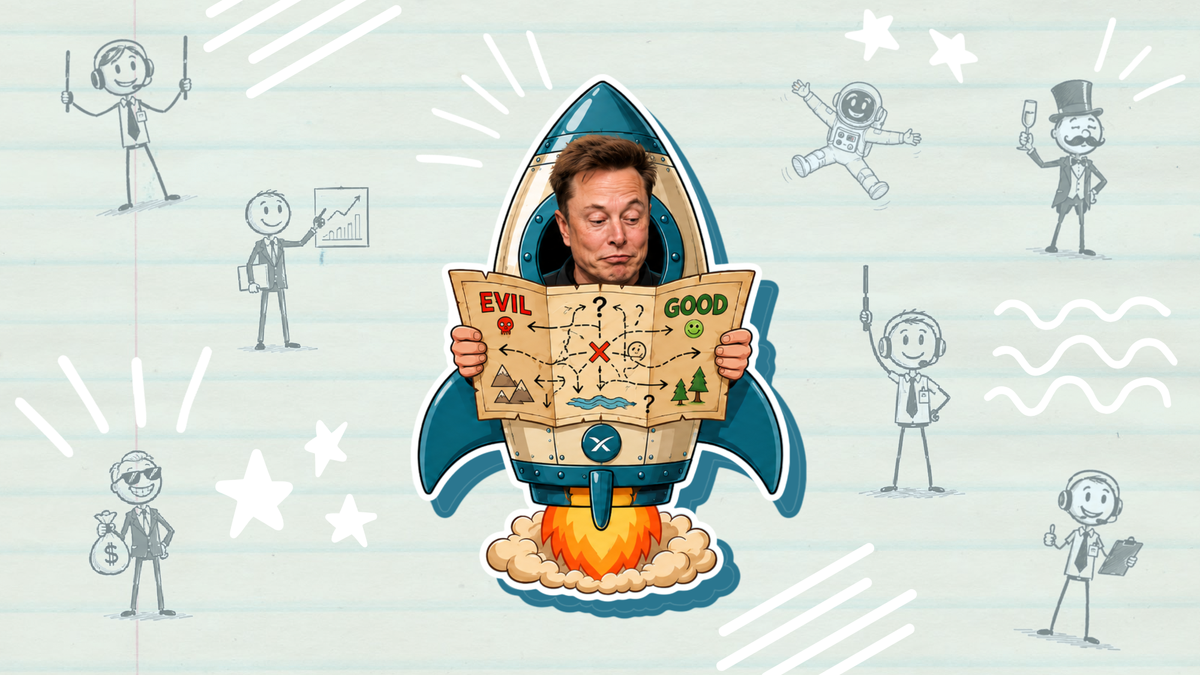

🗂️ Background: Elon Musk is the founder, CEO, CTO, board chairman, and principal shareholder of SpaceX, a company designed to "build the systems and technologies necessary to make life multiplanetary" and "understand the true nature of the universe." On June 12, 2026, SpaceX shares began trading on Nasdaq, in what the exchange called "the most anticipated and largest initial public offering in Wall Street history." Forbes quickly crowned Musk the world’s first trillionaire – forcing a complicated conversation about the extremes of capitalism.
Can you really earn a trillion dollars?
U.S. Representative Alexandria Ocasio-Cortez (D) – a Democratic Socialist who the DSA calls their "foremost socialist superstar" – has publicly claimed:
"There is a certain level of wealth and accumulation that is unearned, right? You can't earn a billion dollars. You just can't earn that."
And yet, the stories of countless billionaires suggest otherwise.
Take Elon Musk:
The majority of Musk’s wealth is tied up in ownership shares of his two largest companies, SpaceX and Tesla – a scenario known as "paper wealth" (i.e., stocks/options that would need sold or borrowed against before turning into spendable cash). The only reason Musk’s shares are valued so high is because millions of independent market participants decided – via freewill – that the goods/services produced by SpaceX and Tesla are valuable. Musk’s companies quite literally earned the value that the market then assigned to his shares.
If Musk ever stops earning that value – say if SpaceX pivots to producing pencil erasers instead of stuff like the world’s first orbital-class reusable rocket – then his wealth would plummet.
NOTE: Ocasio-Cortez’s argument also collapses under application of a more technical interpretation of earnings (which the Bureau of Labor Statistics defines as "money received for work or services performed during a specific period"), as Ocasio-Cortez mistakenly conflates earnings with net worth and equity value when critiquing the "economic elite." Elon Musk didn’t earn a trillion-dollar paycheck that he can cash and spend at Disney World. His companies created value, market participants decided how much that value was worth (and assigned it to his shares), and Musk’s net worth increased – which are two totally different things.
How did Elon Musk get a trillion dollars?
Musk’s trillionaire status – which, again, exists primarily on paper – is a result of SpaceX’s recent IPO launch, compounded with existing wealth (see Musk’s other ventures, below).
On June 12, 2026, SpaceX offered 555,555,555 shares of Class A common stock at $135/share; trading opened at $150/share and closed at $160.95, initially raising $75 billion – resulting in an "unprecedented" implied valuation of roughly $1.77 trillion.
Musk beneficially owned 849,494,440 shares of Class A common stock and 5,569,053,075 shares of Class B common stock before the IPO – which skyrocketed (pun intended!) his net worth to $1.1 trillion by the close of trading on Friday, June 12. That same day, Forbes named Musk the world’s first trillionaire.
NOTE: Prior to Friday, Forbes estimated Musk’s net worth at $982 billion.
At the time of writing (June 16), SpaceX’s market capitalization sits at $2.6 trillion [see archived data]; gross proceeds are $85.7 billion.
What is Elon Musk’s job?
As Adam Smith famously wrote in The Wealth of Nations:
"It is not from the benevolence of the butcher, the brewer, or the baker, that we expect our dinner, but from their regard to their own interest..."
(And we've clearly seen how Musk's interests have benefited!).
So – in the context of free-market capitalism – what has Elon Musk brought to the table?
NOTE: Musk’s jobs (past and present) are listed below, along with a brief description of each company’s mission. Details re: specific economic and societal contributions are provided in the following sections.
For confirmation re: roles/position titles, see: SpaceX’s U.S. Final Prospectus Filed with the SEC.
How has Musk contributed to the economy?
In defending free-market capitalism, Nobel-prize winning economist Milton Friedman notes:
"The big difference between government coercion and private markets is that government can use coercion to make an exchange in which A benefits and B loses. But in the market, if A and B come to a voluntary agreement, it's because both of them are better off."
As mentioned, we’ve already seen how Musk is better off – but, by Friedman’s logic: if consumers have voluntarily assigned Musk wealth, it must be because they’re getting something in return. So what's the trade-off?
To date, Musk-led companies have:
DETAILS : Current data places Tesla’s (TSLA) market capitalization, or public market value, at roughly $1.5 trillion and SpaceX (SPCX) at $2.6 trillion [see archived data: 1, 2]. In 2025, Tesla generated $94.83 billion in revenue; SpaceX reported $18.7 billion. That same year, Tesla reported $8.53 billion in capital expenditures and $6.41 billion in research and development; SpaceX reported $20.7 billion in capital expenditures. As of December 31, 2025, Tesla reports 134,785 worldwide employees.
How do Musk’s economic contributions impact "regular" people?
Trillions in Market Value: When a company trades on a public exchange – like Nasdaq – investors assign it a public market value (i.e., how much they think it's worth). Companies with high market values help the economy in a number of ways. For starters, since a lot of Americans hold stocks through major funds – like 401(k)s, IRAs, pension funds, college savings accounts, and brokerage accounts – individuals can benefit greatly when the stocks those funds hold increase in market value. A high public value can also create trickle-down wealth for employees who hold stock options and empower companies to raise capital – leading to the creation of real-world infrastructure (like medical and technological advances).
$100 Billion+ Annual Revenue: Large-scale revenue translates into money that supports workers, suppliers, factories, vendors, construction, and local communities (money keeps moving down the line!).
Billions in Capital Expenditures: Investments that companies make on long-term assets (think factories, technology, infrastructure) are called capital expenditures. These types of expenses often lead to broader benefits for everyone (factories can employ workers, satellites can provide internet, etc.).
Billions in Research & Development: Likewise, money spent on research and development can build future industries – or change the course of current ones.
130K+ Jobs: Just one of Musk’s companies alone (Tesla) has generated direct livelihoods for 134,785 people.
How has Musk contributed to society?
While beyond the scope of this toolkit to list in full, a few Musk-led company highlights include:
✏️ The Left Has a Point: A widely shared CNN article makes a valid point: Musk-led companies did benefit from government assistance, and – to the article’s strongest argument – that help did arrive at mission critical moments. However, the headline itself – How much of Musk’s wealth comes from government help? Virtually all of it – is misleading.
CNN’s claim treats grants, loans, contracts, tax credits, and regulatory policies as if they’re all the same (lumping the wildly different programs into one bucket: "government help"). It also paints NASA’s 2006 SpaceX grant ($278 million) as a "windfall" – giving the impression that NASA’s grant was more of a handout, versus the milestone-based Space Act Agreement (with legally enforceable commitments) that it actually was. According to NASA, in return for the money it gave SpaceX, Musk’s company "[restored] an American capability to deliver and return cargo for the first time since the retirement of the space shuttle in 2011."
The article further characterizes NASA’s 2008 support of SpaceX as unique or favoritism (calling the fixed-price contract "unprecedented") – when, in fact, NASA awarded more money to SpaceX’s competitor, Orbital, in the exact same award cycle. (Also missing from the critique is NASA’s 2014 award to another SpaceX competitor – Boeing received a $4.2 billion contract, SpaceX: $2.6.)
Lastly, CNN minimizes pivotal details (including the fact Tesla paid off its $465 million Department of Energy loan nine years early, with interest) and erroneously concludes that NASA got the short end of the stick because it didn’t benefit like "private investors" – when, unlike private investors, NASA’s stated objective was never to "get rich." By its own accord, NASA’s priorities were to "stimulate commercial enterprises in space" and "facilitate U.S. private industry demonstration of cargo and crew space transportation capabilities" – both goals that SpaceX accomplished.
CNN makes a strong point re: regulatory credits (they helped Tesla immensely), but again: its conclusion is overdrawn.
Did Musk-led companies – like many major corporations – benefit from government assistance? Absolutely. As Musk himself acknowledged in 2012:
"We could not have started SpaceX nor could we have reached this point without the help of NASA."
But did that help result in "virtually all" of Musk’s wealth? Absolutely not.
As critics call for the redistribution of Musk’s wealth, Frédéric Bastiat’s famous warning comes to mind:
"But how is this legal plunder to be identified? Quite simply. See if the law takes from some persons what belongs to them, and gives it to other persons to whom it does not belong. See if the law benefits one citizen at the expense of another by doing what the citizen himself cannot do without committing a crime. Then abolish this law without delay…"
For more on the moral consequences of capitalism, I strongly recommend watching Milton Friedman’s speech: Is Capitalism Humane?.
☀️ If all this financial talk has you never wanting to think about money again, I encourage you to brighten your day by giving some away :-)
💸 Remember: Free-market capitalism opposes the forced redistribution of wealth – not voluntary generosity, charity, or compassion for our fellow man (which Quick Conservative is all about!).
👷🏻♀️ Today’s recommendation is an oldie but a goodie: Habitat for Humanity (last year, they helped over 3 million people build or improve their homes!).
✝️ Command those who are rich in this present age not to be haughty, nor to trust in uncertain riches but in the living God, who gives us richly all things to enjoy. – 1 Timothy 6:17
Bastiat, F. (1850). The Law. [E-book version: 2012, November 16.] Foundation for Economic Education.
Bauer, P. (2026, June 14). Zip2. Britannica Money.
Durot, M. (2026, June 12). SpaceX’s IPO just made Elon Musk the world’s first trillionaire. Forbes.
Fisher, J. (2025, February 17). Declaration of Joshua Fisher [Declaration]. In State of New Mexico et al. v. Elon Musk et al., No. 1:25-cv-00429 (D.D.C.).
Forbes PR. (2026, June 12). Forbes declares Elon Musk as the world’s first trillionaire. Forbes.
Friedman, M. (n.d.). An interview with Milton Friedman: America’s best known libertarian economist [Interview transcript]. In Commanding Heights: The Battle of Ideas: Part One. PBS/WGBH.
Friedman, M. (1978). Milton Friedman Speaks: Is Capitalism Humane? [Video lecture; recorded at Cornell University]. Free To Choose Network. YouTube.
Habitat for Humanity International. (n.d.). Habitat for Humanity.
Habitat for Humanity International. (2025). Home is the foundation: FY2025 annual report.
Isidore, C. (2026, June 13). How much of Musk’s wealth comes from government help? Virtually all of it. CNN.
It’s Open with Ilana Glazer. (2026, May 7). Alexandria Ocasio-Cortez on waitressing and the power of the vibe | It’s Open with Ilana Glazer [Video]. YouTube.
Nasdaq. (2026, June 16). Space Exploration Technologies Corp. Class A Common Stock (SPCX) stock price, quote, news & history. [Archived Data]
Nasdaq. (2026, June 16). Tesla, Inc. Common Stock (TSLA) stock price, quote, news & history. [Archived Data]
Nasdaq Newsroom. (2026, June 12). SpaceX (SPCX): Rocket company launches historic IPO. Nasdaq.
National Aeronautics and Space Administration. (2013, November 13). NASA hails success of commercial space program private space station resupply underway, plans readied for astronauts (Release No. 13-334).
National Aeronautics and Space Administration, & Space Exploration Technologies Corp. (2006, August 18). Space Act Agreement between National Aeronautics and Space Administration and Space Exploration Technologies Corp. for Commercial Orbital Transportation Services demonstration (COTS) (Agreement No. NNJ06TA26A).
Neuralink. (2026, January 28). Two years of Telepathy.
Neuralink Corp. (n.d.). Neuralink: Pioneering brain computer interfaces.
McIntosh, D. (2021, March 19). Talking socialism | Catching up with AOC. Democratic Socialists of America.
PayPal, Inc. (n.d.). PayPal.
Smith, A. (2003). The wealth of nations (E. Cannan, Ed.; A. B. Krueger, Introduction). Bantam Classics. (Original work published 1776).
Space Exploration Technologies Corp. (n.d.). SpaceX.
Space Exploration Technologies Corp. (2026, June 4). Free writing prospectus [SEC filing]. U.S. Securities and Exchange Commission.
Space Exploration Technologies Corp. (2026, June 11). Free writing prospectus: 555,555,555 shares of Class A common stock [SEC filing]. U.S. Securities and Exchange Commission.
Space Exploration Technologies Corp. (2026, June 11). Space Exploration Technologies Corp. announces pricing of initial public offering [Press release].
Space Exploration Technologies Corp. (2026, June 12). Prospectus: 555,555,555 shares of Class A common stock [SEC filing]. U.S. Securities and Exchange Commission.
Space Exploration Technologies Corp. (2026, June 15). Space Exploration Technologies Corp. announces closing of initial public offering, including full exercise of underwriters’ option to purchase additional shares [Press release].
SpaceX. (n.d.). Falcon 9.
Tesla, Inc. (n.d.). Tesla.
Tesla, Inc. (2026, January 28). Annual report on Form 10-K for the year ended December 31, 2025 [SEC filing]. U.S. Securities and Exchange Commission.
Tesla, Inc. (2026, April 30). Amendment no. 1 to annual report on Form 10-K/A for the year ended December 31, 2025. U.S. Securities and Exchange Commission.
Tesla Motors, Inc. (2012, February 27). Annual report on Form 10-K for the year ended December 31, 2011 [SEC filing].
The Boring Company. (n.d.). The Boring Company.
U.S. Department of Energy. (n.d.). Tesla. Office of Energy Dominance Financing.
U.S. Department of Justice, Office of Public Affairs. (2026, June 16). U.S. Justice Department moves to intervene in race discrimination lawsuit challenging reparations program in Evanston, Illinois.
U.S. Department of the Treasury, Bureau of the Fiscal Service. (n.d.). USAspending.gov.
U.S. Securities and Exchange Commission. (n.d.). Stocks - FAQs. Investor.gov.
United States’ Motion to Intervene, Flinn v. City of Evanston, No. 1:24-cv-04269 (N.D. Ill. June 16, 2026).
X Corp. (n.d.). Home.
xAI Corp. (n.d.). xAI.
WME Group, LLC. (n.d.). WME Group. [Endeavor Group Holdings, Inc.]
Yahoo Finance. (n.d.). Space Exploration Technologies Corp. (SPCX) historical data.
I really want to make sure I’m writing about stuff you guys want to read, so please don’t be shy – let me know what topics you want researched next! Feel free to email me directly :-)