Can Police Access Your Location Data? Maybe...
SCOTUS: "Dumb flip-phone days" are over


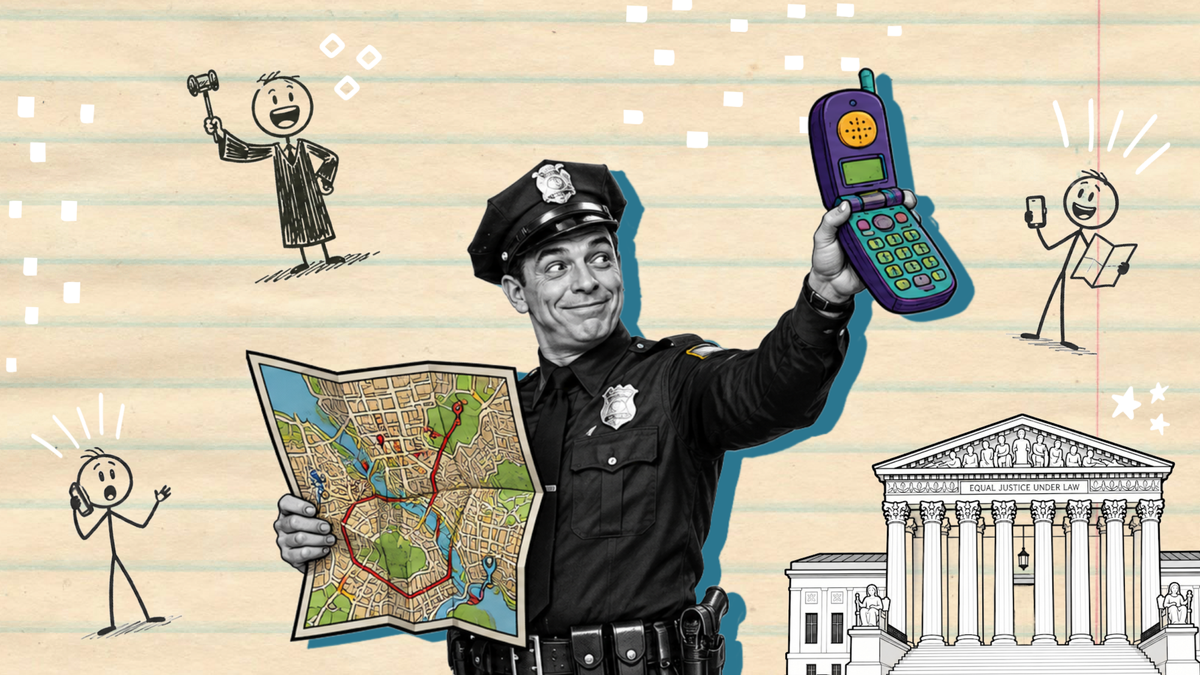

🗂️ Background: In 2019, a man robbed a credit union in Virginia. After serving Google a "geofence warrant," law enforcement used cell phone location data to identify and charge the suspect, Okello Chatrie. Chatrie then moved to suppress the geofence evidence – arguing its use violated his Fourth Amendment rights. Yesterday, the Supreme Court weighed in – supporting cell phone privacy, but declining to rule that geofence warrants are, in and of themselves, unconstitutional.
What is a geofence warrant?
A "geofence warrant" requires a service provider to produce location data from cell phone users who were near a scene when a crime occurred. In this particular case, police solicited cell phone data from Google for all users within 150 meters of the credit union (30 minutes before and after the robbery).
For perspective, the U.S. Court of Appeals for the Fourth Circuit notes that Google collects the location history of over 500 million users – logging "remarkably extensive" location data every two minutes, including elevation (ex., if you’re in a building, Google can tell what floor).
What does the Fourth Amendment say?
The Fourth Amendment states:
"The right of the people to be secure in their persons, houses, papers, and effects, against unreasonable searches and seizures, shall not be violated, and no Warrants shall issue, but upon probable cause, supported by Oath or affirmation, and particularly describing the place to be searched, and the persons or things to be seized."
What are the arguments in favor of geofence warrants?
⚠️ Careful compliance: The biggest argument for geofence warrants is that they provide law enforcement with a powerful way to solve crimes that may otherwise go unresolved (think kidnappings, etc). In Chatrie, prosecutors pointed to Google’s cautious execution of the warrant as an example of responsibly sourcing geofence evidence (Google initially supplied anonymized data, police narrowed the suspect pool, and then Google only revealed those identities).
↔️ Narrowly tailored: Proponents argue that if the warrant is specific enough, it should count. For instance, prosecutors claimed that since Chatrie used a phone during the robbery – and police knew when/where the robbery took place – soliciting phone data for that specific time/place is supported by probable cause.
🕵🏻♂️ Voluntary exposure: Since users opt in to cell phone terms (and can often control their location data), prosecutors argued that by opting in/not turning off tracking settings, Chatrie was voluntarily exposing his data to Google – giving up any "reasonable expectation of privacy."
What are the arguments against geofence warrants?
😳 Violates Fourth Amendment: The Constitution requires law enforcement to have probable cause before issuing a warrant. Critics argue that geofence warrants turn the process upside down: instead of identifying a suspect and then issuing a warrant, police issue a warrant for a group of people and then work backwards.
🛑 Non-voluntary exposure: Chatrie’s defense argued that simply opting into Google’s terms of service (and not turning off location tracking) didn’t constitute acknowledgment (or "meaningful consent") that his information could be handed over to the government.
What did earlier courts say?
On March 3, 2022, the U.S. Court for the Eastern District of Virginia denied Chatrie's motion to suppress geofence evidence. While admitting the warrant had serious Fourth Amendment problems (including lack of particularized probable cause), the district court ruled it could stand under the "good-faith exception" (see next section for details). Chatrie then entered a conditional guilty plea (reserving the right to appeal the geofence issue) and was sentenced to 141 months in prison.
On July 9, 2024, a three-judge panel of the U.S. Court of Appeals for the Fourth Circuit affirmed the denial, ruling law enforcement did not conduct a Fourth Amendment search because Chatrie voluntarily exposed his location history to Google.
On January 30, 2025, the Fourth Circuit heard the case en banc (meaning the full court, not just three judges). On April 30, 2025, the Fourth Circuit affirmed the denial of suppression – but the judges were deeply divided, issuing multiple opinions disagreeing over Fourth Amendment issues.
Chatrie then petitioned the U.S. Supreme Court (SCOTUS) and, on January 16, 2026, SCOTUS agreed to accept the case (offering to rule on whether the geofence warrant violated the Fourth Amendment, but declining to consider the good-faith/exclusionary rule topic).
What is a good-faith exception?
Courts are not allowed to consider evidence collected in violation of a defendant’s constitutional rights – a principle known as the "exclusionary rule."
In 1984 (United States v. Leon), the Supreme Court created an exception to the exclusionary rule called the "good-faith exception." In a nutshell, it states that even if a warrant is later found to be unconstitutional, the evidence it produced may still be used if law enforcement acted "in reasonable reliance on a search warrant issued by a detached and neutral magistrate."
When the Chatrie case was first heard, the U.S. District Court for the Eastern District of Virginia acknowledged major Fourth Amendment problems – but ultimately decided they didn’t matter because the geofence warrant fell under a good-faith exception. Law enforcement successfully argued the rule applied because detectives consulted with government attorneys, had previously obtained similar warrants, no court had yet ruled against geofence warrants, and the technology was new/novel. In other words, they had "good faith" that their warrant was legal.
Importantly, while Chatrie asked the Supreme Court to rule on whether the exclusionary rule should apply to the geofence evidence used in his case, SCOTUS declined – only agreeing to review whether the execution of a geofence warrant violated the Fourth Amendment.
What did the Supreme Court say?
On June 29, 2026, the Supreme Court defended constitutional protection for cell phone location data. However, the SCOTUS decision does not mean that all geofence warrants are automatically unconstitutional. Instead, it:
1) Confirms that geofence warrants do count as Fourth Amendment searches ("because an individual has a reasonable expectation of privacy in his cell phone location information"); and,
2) Sends the Chatrie case back to the lower courts to decide whether, at each step of the search process (i.e., the "careful compliance" process outlined above), this specific geofence warrant "satisfied the Fourth Amendment’s requirements of particularity and probable cause."
For context, the decision referenced Justice Brandeis’s dissent in Olmstead v. United States (1928), where Brandeis argued that wiretaps are subject to Fourth Amendment protections. In 1967, Katz v. United States made it official:
"The Government’s activities in electronically listening to and recording the petitioner’s words [via a telephone booth]… constituted a 'search and seizure' within the meaning of the Fourth Amendment."
Today’s decision re: location data can be understood in the same way as wiretap warrants:
The process itself is not forbidden, but it can only be used under highly specific circumstances that meet all Fourth Amendment requirements (e.g., particularity and probable cause). It’ll be up to judges – on a case-by-case basis – to decide if a requested geofence warrant meets such standards.
Note: The Supreme Court agreed with Chatrie: opting in to cell phone terms/not turning off location tracking does not waive privacy expectations:
"Pretty much everything a person does on a smartphone requires some kind of opt-in – an 'affirmative act' beyond 'powering up' to utilize a given app or service. Consider sending an email on Gmail, uploading a photo to Google Photos, or adding a calendar entry to Google Calendar. None happens solely by dint of the phone’s operation; each requires, as Location History does, an 'optional add-on.' And each activity, like using Location History, results in sharing information with a third-party tech company – turning over private materials to live on that company’s servers.
The Government [Prosecution] wishes to disconnect all those uses from the mere act of carrying a turned-on cell phone (the thing that generates cell-site location information), with only the latter receiving assured Fourth Amendment protection. But that is to imagine that all of us are living in dumb flip-phone days. The point of carrying smartphones is to use what is on them."
In conclusion, the Supreme Court writes:
"An individual has a reasonable expectation of privacy in records about his cell phone’s location, and police intrude on that constitutionally protected interest when they demand the information – even though for only a limited time, and from a third-party tech company. We leave to the Court of Appeals the further question whether, given the warrant issued, the search here was reasonable, meaning that each of its steps was properly described with particularity and found to be supported by probable cause."
✏️ The Left Has a Point: The three Democrat-appointed Justices (Kagan, Sotomayor, Jackson) all sided with Chatrie on the core issue, agreeing that the geofence warrant did constitute a Fourth Amendment search. However, the topic wasn’t a clear ideological divide: two Republican-appointed Justices (Roberts and Kavanaugh) joined the majority, and a third Republican-appointed Justice (Gorsuch) agreed with the judgment, while the remaining three Republican appointees (Alito, Thomas, Barrett) dissented.
Alito’s dissent (joined by Thomas) argued that the new ruling is too broad – muddying Fourth Amendment waters even more than Carpenter v. United States (another cell phone/Fourth Amendment case where Alito dissented) – adding that this particular case wasn’t the right vehicle for considering the issue. Per Alito:
"Although today’s decision will send seismic waves through our Fourth Amendment doctrine, not one iota of the majority opinion will affect the outcome of this case. The Court knows this and does not claim otherwise. Indeed, by refusing to review the one question [re: good-faith exception] that could have at least theoretically given Chatrie some hope of relief, the Court carefully set the stage for its planned performance: striking a pose as a great champion of privacy in the digital age. I cannot support this irresponsible escapade."
Alito, Thomas, and Barrett also felt that Chatrie did voluntarily supply information/forfeit his expectation of privacy.
However, all Democrat-appointed Justices – along with three Republican appointees – disagreed, illustrating a unique issue not clearly defined by political leanings.
Geofence warrants aren't the only way people can access your location data. During COVID, the Centers for Disease Control and Prevention (CDC) paid $420,000 to data broker, SafeGraph, to monitor the location data of tens of millions of Americans.
Documents obtained by Vice Motherboard through a Freedom of Information Act request and published on May 3, 2022, show that the CDC bought access to location data for millions of U.S. phones to track curfew compliance, visits to pharmacies, and mobility patterns involving schools, "places of worship," and more.
As the report explains:
"SafeGraph is part of the ballooning location industry [...] Generally, companies in this industry ask, or pay, app developers to include location data gathering code in their apps. The location data then funnels up to companies that may resell the raw location data outright or package it into products."
For tips on managing your location data, see the "cheatsheet" section above.
💧Over 696 million people worldwide lack access to clean and safe water...
🗺️ charity: water (yes, lowercased “c”) uses 100% of each donation to fund clean water around the world and then "proves" every project you fund with GPS coordinates and photos :-)
📝 They even publish their financial audits so you know every cent you share is going directly to those in need!
✝️ Then the Lord answered Job out of the whirlwind, and said: "Who is this who darkens counsel by words without knowledge? Now prepare yourself like a man; I will question you, and you shall answer Me.
Where were you when I laid the foundations of the earth? Tell Me, if you have understanding. Who determined its measurements? Surely you know! Or who stretched the line upon it? To what were its foundations fastened? Or who laid its cornerstone, when the morning stars sang together, And all the sons of God shouted for joy?"
[...] Moreover, the Lord answered Job, and said: "Shall the one who contends with the Almighty correct Him? He who rebukes God, let him answer it." – Job 38: 1-7 + Job 40: 1-2
Apple. (n.d.). Control the location information you share on iPhone. Apple Support.
Carpenter v. United States, 585 U.S. 296 (2018).
Charity Global, Inc. and Affiliate. (2024). Consolidated financial statements and supplementary information: September 30, 2024 (with independent auditors’ report thereon).
charity: water. (n.d.). Bring clean and safe water to every person on the planet.
Chatrie v. United States, 609 U.S. ___ (2026).
Cox, J. (2022, May 3). CDC tracked millions of phones to see if Americans followed COVID lockdown orders. VICE.
Google. (n.d.). Manage your Android device’s location settings. Android Help.
Google. (n.d.). Manage your Timeline data. Google Account Help.
Joint Appendix Volume 6, United States v. Chatrie, No. 22-4489, Doc. 19-6 (4th Cir. Jan. 20, 2023).
Katz v. United States, 389 U.S. 347 (1967).
National Archives. (2025, August 7). The Bill of Rights: A transcription.
Olmstead v. United States, 277 U.S. 438, 471 (1928).
Petition for a Writ of Certiorari, Chatrie v. United States, No. 25-112 (U.S. July 28, 2025).
Supreme Court of the United States. (n.d.). Docket for 25-112: Okello T. Chatrie, petitioner v. United States.
Supreme Court of the United States. (n.d.). Opinions of the court – 2025.
Supreme Court of the United States. (2026, January 16). Order list: 607 U.S.
Trump v. Slaughter, 609 U.S. ___ (2026).
United States v. Chatrie, 590 F. Supp. 3d 901 (E.D. Va. 2022).
United States v. Chatrie, 107 F.4th 319 (4th Cir. 2024), vacated, 136 F.4th 100 (4th Cir. 2025).
United States v. Chatrie, 136 F.4th 100 (4th Cir. 2025) (en banc).
United States v. Leon, 468 U.S. 897 (1984).
Watson v. Republican National Committee, 609 U.S. ___ (2026).
World Health Organization & United Nations Children’s Fund. (2025). Progress on household drinking water, sanitation and hygiene 2000–2024: Special focus on inequalities. WHO and UNICEF.
Supreme Court opinions might sound intimidating (especially given their length!); however, they’re surprisingly straightforward and easy to read/understand. I can’t encourage you enough to check out the full Chatrie ruling and the others listed in today’s "cheatsheet" section (you can also access all SCOTUS decisions here!).